
After pulling another 12-hour shift watching patients suffer, traditional talk therapy can feel like trying to empty an ocean with a teaspoon. You sit across from a well-meaning therapist, describing the weight of every code blue, every family you’ve watched break apart, every moment you’ve held someone’s hand as they took their last breath—but words feel inadequate. The trauma isn’t just in your mind; it’s lodged deep in your nervous system, in the subcortical brain where your body holds the memory of every patient you couldn’t save. This is where brainspotting for healthcare workers offers something different: a specialized approach that reaches trauma where it actually lives.
Why Traditional Therapy Often Falls Short for Healthcare Professionals
Healthcare workers face a unique constellation of stressors that standard therapeutic approaches weren’t designed to address. Unlike single-incident trauma, healthcare worker burnout therapy must account for the cumulative weight of repeated exposure to human suffering, life-and-death decisions, and the chronic stress of an overburdened system.
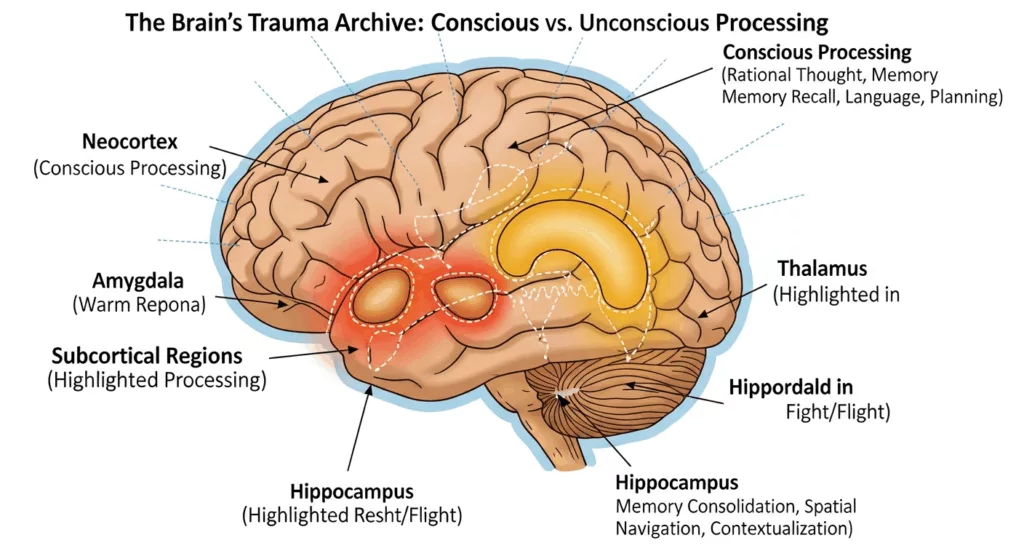
Traditional talk therapy operates primarily through the neocortex—the thinking brain. It relies on cognitive processing, insight, and verbal articulation of experiences. But here’s the problem: much of healthcare trauma gets stored in the subcortical brain, the deep limbic system where fight-or-flight responses live. This is why you might understand logically that a patient’s death “wasn’t your fault” while still experiencing panic attacks every time you hear a code blue called.
Research from the Agency for Healthcare Research and Quality shows that healthcare worker burnout affects up to 50% of physicians and nurses. Yet traditional interventions often focus on surface-level coping strategies rather than addressing the neurobiological impact of repeated trauma exposure.
Consider these common scenarios that illustrate why conventional approaches fall short:
- The ICU nurse who can discuss her patients’ deaths rationally but experiences intrusive flashbacks during quiet moments
- The emergency physician who understands trauma intellectually but finds himself hypervigilant and sleepless after particularly difficult shifts
- The respiratory therapist who can articulate her stress clearly but still feels physical panic when entering certain patient rooms
These professionals aren’t “treatment-resistant”—they’re experiencing trauma responses that live below the level of conscious thought and verbal processing.
Understanding Brainspotting: The Science Behind Subcortical Processing
Brainspotting, developed by Dr. David Grand in 2003, operates on a fundamental principle: “Where you look affects how you feel.” This isn’t mysticism—it’s based on solid neuroscience about how the brain stores and processes traumatic experiences.
The technique works by identifying specific eye positions (“brainspots”) that access traumatic memories and emotions stored in the subcortical brain. Unlike therapies that rely heavily on talking and thinking, brainspotting trauma therapy allows the brain’s natural healing capacity to process trauma without forcing it through the cognitive bottleneck of language.
The Neurological Foundation
When healthcare workers experience repeated trauma, several brain systems become dysregulated:
- The amygdala becomes hyperactive, constantly scanning for threats
- The hippocampus struggles to properly encode traumatic memories, leaving them “stuck” in an unprocessed state
- The prefrontal cortex becomes overwhelmed, making rational decision-making more difficult
- The autonomic nervous system remains in a chronic state of activation
Brainspotting accesses these areas directly through the brain’s visual field, bypassing the often-overwhelmed cognitive processing centers. The eye position creates a window into the subcortical brain where trauma is actually stored.
How Brainspotting Differs from Other Approaches
While therapies like EMDR also work with eye movements, brainspotting takes a different approach. Rather than following a prescribed protocol, the therapist helps identify the specific eye position that activates the traumatic material most strongly. Then, the client simply maintains that gaze while allowing the brain to process whatever emerges—without forcing insight or understanding.
This approach is particularly powerful for healthcare workers who may be intellectually “over-processing” their trauma while remaining stuck in nervous system dysregulation.
How Brainspotting Addresses Healthcare-Specific Trauma and Burnout
Healthcare professionals carry unique forms of trauma that require specialized understanding. Compassion fatigue treatment must address not just individual traumatic incidents, but the cumulative neurobiological impact of chronic stress and repeated trauma exposure.
Moral Injury and Its Subcortical Impact
One of the most challenging aspects of healthcare trauma is moral injury—the deep wound that occurs when you’re prevented from providing the care you know patients need due to systemic constraints. This isn’t just psychological distress; it creates profound neurobiological disruption.
A study published in the National Center for Biotechnology Information found that moral injury among healthcare workers creates lasting changes in brain structures associated with stress regulation and emotional processing.
Brainspotting can access and process these deep-seated moral injuries in ways that traditional talk therapy often cannot. By working directly with the subcortical brain, it helps release the trapped activation around situations where you “should have done more” or “could have saved them.”
Processing Cumulative Trauma
Unlike single-incident trauma, healthcare workers experience what researchers call “complex trauma”—repeated exposure to potentially traumatic events over months or years. This creates layered trauma responses that can be difficult to untangle through conventional approaches.
Brainspotting allows the brain to process these layered experiences organically, without needing to separate and analyze each incident. The subcortical brain often knows exactly what needs to be processed and in what order—if we give it the space to do so.
Addressing Secondary Trauma
Healthcare workers also absorb trauma from their patients’ experiences. This secondary trauma can be particularly challenging because it often feels “less valid” than direct trauma—even though its neurobiological impact can be just as significant.
Research shows that compassion fatigue affects the same brain regions as direct trauma exposure, making specialized intervention crucial for recovery.
Brainspotting helps process these absorbed traumatic experiences without minimizing their impact or requiring healthcare workers to “justify” their responses to others’ pain.
The Unique Challenges of Highly Sensitive Healthcare Workers
Many people drawn to healthcare careers are naturally empathic and sensitive to others’ suffering. While these qualities make them exceptional caregivers, they also create vulnerability to particular forms of burnout and trauma.
Highly sensitive healthcare professionals often experience:
- Deeper emotional resonance with patient suffering
- Difficulty setting energetic boundaries between work and personal life
- Physical symptoms of absorbed trauma (headaches, digestive issues, sleep problems)
- Tendency to minimize their own needs while caring for others
- Perfectionist tendencies that amplify self-criticism when outcomes aren’t ideal
The Nervous System Impact of High Sensitivity
Highly sensitive healthcare workers often have more reactive nervous systems—their fight-or-flight responses activate more easily and take longer to calm down. This isn’t weakness; it’s a neurological difference that requires specialized approaches to healing.
Traditional therapy approaches that rely heavily on “talking through” experiences can sometimes overwhelm already-activated nervous systems. Brainspotting offers a gentler approach that works with the nervous system’s natural capacity for regulation and healing.
Processing Empathic Overload
Highly sensitive healthcare workers often absorb not just their patients’ physical pain, but their emotional and existential suffering as well. This “empathic overload” can create a unique form of burnout that feels like carrying the weight of every person you’ve ever tried to help.
Brainspotting can help process and release these absorbed energies and emotions, allowing healthcare workers to maintain their natural empathy while developing better energetic boundaries.
Research Evidence: Brainspotting Outcomes for Helping Professionals
While brainspotting is a relatively newer therapeutic approach, emerging research demonstrates its effectiveness for trauma treatment, particularly for helping professionals who experience complex, cumulative trauma exposure.
Neurobiological Changes
Brain imaging studies show that brainspotting creates measurable changes in areas of the brain associated with trauma storage and stress regulation. These changes include:
- Decreased amygdala reactivity to trauma triggers
- Improved prefrontal cortex regulation
- Enhanced hippocampal function for memory processing
- Better integration between brain hemispheres
Clinical Outcomes for Healthcare Workers
Studies specifically examining trauma therapy outcomes for healthcare workers show promising results for brainspotting interventions:
- Reduced PTSD symptoms: Significant decreases in intrusive memories, hypervigilance, and avoidance behaviors
- Improved sleep quality: Better sleep onset and decreased trauma-related nightmares
- Enhanced emotional regulation: Greater capacity to manage intense emotions without becoming overwhelmed
- Decreased physical symptoms: Reduction in tension headaches, digestive issues, and other stress-related physical symptoms
- Improved job satisfaction: Renewed sense of purpose and connection to healthcare work
The CDC’s National Institute for Occupational Safety and Health has recognized the need for specialized interventions that address the unique stressors healthcare workers face.
Speed of Treatment
One significant advantage of brainspotting for busy healthcare workers is the efficiency of treatment. While traditional trauma therapy can take months or years, brainspotting often produces significant results in fewer sessions.
This doesn’t mean the work is superficial—rather, by working directly with the subcortical brain, brainspotting can access and process core traumatic material more efficiently than approaches that rely primarily on cognitive processing.
What to Expect: Brainspotting Sessions for Healthcare Workers in Florida
If you’re a healthcare worker in Florida considering brainspotting, understanding what to expect can help you make an informed decision about this specialized approach to burnout recovery for nurses and other healthcare professionals.
Initial Assessment and Preparation
Your first session will involve a thorough assessment of your trauma history, current symptoms, and treatment goals. This includes:
- Discussion of your healthcare work environment and specific stressors
- Assessment of trauma symptoms (sleep, concentration, emotional regulation)
- Evaluation of your nervous system’s current state of activation
- Education about how trauma affects the brain and body
- Explanation of the brainspotting process
The Brainspotting Process
During brainspotting sessions, you’ll work with your therapist to identify specific eye positions that activate traumatic material. This process typically involves:
- Setup: You’ll be seated comfortably while your therapist uses a pointer to guide your gaze across your visual field
- Activation: As you think about traumatic experiences, you’ll notice where in your visual field you feel the most activation or disturbance
- Processing: You’ll maintain your gaze at that specific “brainspot” while allowing whatever emerges—emotions, memories, body sensations—to be present
- Integration: Your therapist will help you process what emerged and integrate the experience
Common Experiences During Processing
Healthcare workers often experience unique patterns during brainspotting sessions:
- Body memories: Physical sensations related to specific patient encounters or work situations
- Emotional releases: Grief, anger, or fear that couldn’t be processed during intense work situations
- Systemic awareness: Recognition of how healthcare system dysfunction has impacted you personally
- Renewed purpose: Reconnection with the meaning and value of healthcare work
Telehealth Accessibility
Recognizing that healthcare workers often have demanding and unpredictable schedules, many specialized trauma therapists in Florida offer brainspotting through secure telehealth platforms. This allows you to access treatment from home, even during off-hours or between shifts.
If you’re interested in learning about other evidence-based approaches alongside brainspotting, you might also explore Dialectical Behavior Therapy (DBT), which offers complementary skills for emotional regulation that many healthcare workers find valuable.
Integration and Follow-up
After brainspotting sessions, healthcare workers often benefit from specific integration strategies:
- Nervous system regulation techniques for use during shifts
- Boundary-setting strategies for managing empathic overload
- Self-care practices grounded in trauma science rather than generic wellness advice
- Meaning-making support to reconnect with purpose in healthcare work
For healthcare workers dealing with the broader impacts of trauma, understanding secondary trauma patterns can provide additional insight into recovery processes.
Insurance and Practical Considerations
Many healthcare workers worry about the cost and logistics of specialized trauma treatment. It’s worth knowing that brainspotting is often covered by major insurance plans when provided by licensed trauma specialists. For detailed information about coverage in Florida, you can review resources on insurance coverage for trauma therapy.
Additionally, many trauma specialists offer flexible scheduling, including evening and weekend appointments, recognizing the unique scheduling challenges healthcare workers face.
Moving Forward: Taking the First Step
If you’re a healthcare worker struggling with burnout, trauma symptoms, or the accumulated weight of caring for others, you don’t have to continue carrying this burden alone. Brainspotting offers a specialized approach that honors both your dedication to healing others and your own need for deep, authentic recovery.
The path forward doesn’t require you to stop caring or become less empathetic. Instead, it involves healing the wounded parts of your nervous system so you can continue your important work from a place of strength rather than depletion.
Remember that seeking specialized trauma treatment isn’t a sign of weakness—it’s a recognition that the work you do requires exceptional resilience and that maintaining that resilience sometimes requires professional support designed specifically for the unique challenges you face.
For healthcare workers who have found traditional approaches insufficient, brainspotting represents a science-based path to healing that works with your brain’s natural capacity for recovery. Your dedication to healing others deserves to be matched by access to healing approaches that truly serve your unique needs.
You might also find value in exploring comprehensive approaches like those outlined in evidence-based self-care strategies that complement specialized trauma treatment.
For those interested in cutting-edge approaches, virtual reality trauma therapy represents another innovative option that some healthcare workers find particularly effective.
Are you ready to explore whether brainspotting might be the specialized approach your healing journey has been waiting for? The first step is simply reaching out to learn more about how this evidence-based technique could support your recovery and help you reclaim both your well-being and your sense of purpose in healthcare.